Showing posts with label hacking. Show all posts

Thursday, December 11, 2014

Spanner R5 #amediting Update: Why Does the Future Keep Catching Up With Me?

In the Spanner comics script I did for Script Frenzy in 2008, I opened issue 2 with a Dalek-like security robot summarily executing a one-shot character. Then in Chapter 4 R3, I gave Corporate patriarch Dr. Lars Thorwald, chairman of Biotron, a more advanced production version of a prototype robot that uses an iPod as its head and brain.

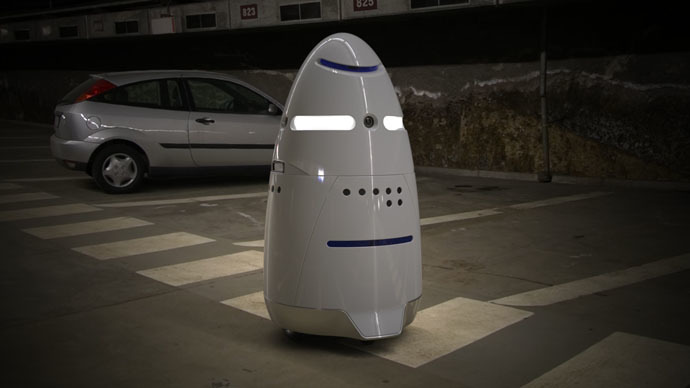
And now this:


The article: <a href="http://rt.com/usa/207395-robocop-security-silicon-valley/">5-foot-tall 'Robocops' start patrolling Silicon Valley</a> (RT.com). The subject: a security robot now policing the streets of San Francisco — and it looks exactly like the one from the Script Frenzy 2008 version of Spanner #2.

Why does the future keep catching up with me?

One thing about speculative fiction is that an author must keep second-guessing the future. My second guesses involve "friendly fascism", the technology of oppression, the cyberpunk truism that the street makes its own uses for things, and the level of tolerance that masses of ordinary people have for tyranny before their desire to live forces them to revolt (and the eagerness of elites to push that tolerance to its limits). Not superheroes, not psychics, not vampires and werewolves and shapeshifters; those belong to my critique of superhero mythology.

My problem is that I've been delaying Spanner's publication for so long that history has started overtaking my speculation. This problem has become so bad that I actually moved the years in which the series takes place from 2014-16 to 2018-20, simply because 2014 had already arrived and thus was no longer speculative. I picked the 2014 date all the way back in 1994, when I aged Shira down from her original 25 down to the Standard Anime Protagonist Age of 15; now I've aged her back up to 19 while keeping her birthdate of September 9, 1999.

Some events that occurred in the middle of writing and editing Spanner:
  1. the 9/11 terrorist attacks and the ensuing invasions of Afghanistan and Iraq in 2001-3, coupled with a "USA PATRIOT" Act that almost convinced me that the "future fascism" I'd been setting the series in since 1992 (if not 1989) had already arrived;
  2. the death of Steve Jobs in 2011;
  3. the "Arab Spring" revolutions and Occupy Wall Street movement, both also in 2011, and both of which failed; and
  4. the anti-police-state protests going on as I write this.
On the technology front, progress in aircar, jetpack, hoverboard, and sexbot technology is such that all of them will be in commercial release by 2018. Despite the failure of Google Glass, augmented reality will become common and normal just as tablet computers, which were a pie-in-the-sky technology, have become today. Another new technology I borrowed toward the end of the plotting phase (late 2000s) was the smartphone; later, in the leadup to the NSA surveillance scandal, I gave my hackers and rebels generic smartphones without tracking devices; and now the PiPhone (made from one of those tiny Raspberry Pi computers) has convinced me that, under a Chinese-style phone company/ISP monopoly with massive supercomputers dedicated just to censorship, hackers must kludge up their own smartphones and use secure meshnets for calling without the monopoly's interference.

Even the particular manifestations of the reactionary politics I would later call "the Conservative Revolution" have largely come to pass. Apparently I didn't get dystopian enough to expect the British "panopticon" surveillance policy, the growth of Soviet-style "vote for the ruling-party candidate Or Else" elections in the US, or the return of the Gilded Age capitalist predators who tried in the 1890s to destroy American freedom and are trying yet again. I did throw in a tyrannical megacomputer, but that's almost a cliché of 1960s and '70s science fiction that — surprise! — turns out to have become a reality as well, along with The Terminator's Skynet. It also took me years to realize that the "Conservative Revolution" is really just the ultimate manifestation of the American Civil War that, despite the near universal assumption that it lasted only four years in the 1860s, really started in the seventeenth century (or even the thirteenth, the century of mother country England's Magna Carta) and has never ended.

Yeah, I know, science fiction has a reputation for making predictions that turn out to be not just wrong but impossible. I throw in some impossible things myself, usually to either critique the superhero mythology or pay homage to classic SF. But too much of the SFnal speculation I've put into Spanner since 1992 has already come to pass, and I'm certain a lot more of it will by the time the story begins in 2018.

Now to edit that second-issue opening back into the third chapter of the new Book 2...

Friday, August 17, 2012

Our Cyberpunk World: Your Brain Can Now Be Hacked

The article: Hackers backdoor the human brain, successfully extract sensitive data (Sebastian Anthony, ExtremeTech)

One technology that has become something of a cyberpunk cliché is the brain-computer interface. Recent developments have focused on sinister police uses. Now black-hat hackers have found a way to keep up with the secret police.

Yes, now the black hats can hack people's brains and even leave malware using BCIs. This will become especially dangerous in virtual reality. The defense is the same as that against interrogators and torturers: awareness, and refusal to give in.

Eventually I suspect enterprising programmers will start developing anti-malware systems for the brain...

Friday, July 22, 2011

Real-Life Bad Companies: America's Universities! or, Aaron Swartz and the Great Intellectual Property Heist of 2010

The article: Feds Charge Activist as Hacker for Downloading Millions of Academic Articles (Wired)

Online activist Aaron Swartz, a near-founder of Reddit, has been charged with the federal crime of "hacking" for downloading ostensibly public-domain academic papers. "Hacking" is a term borrowed from the same media panic as "cyberporn". What's he really charged with?
  1. Copyright piracy.
  2. Theft of trade secrets.
You see, these ostensibly "public domain" academic papers are not public domain at all. They are owned by the universities that publish them, under the strictest copyright license of all: not the Digital Millennium Copyright Act that protects corporate entertainment product from the likes of those heinous pirates, namely people who rip their CDs to their hard drive, but the Uniform Trade Secrets Act and Economic Espionage Act which put corporate trade secrets under the same "top secret" protection as military secrets. In this case, the intellectual property protections on the journals the papers are published in are among the strictest in the entire intellectual property field: the licenses are restricted to a select few, namely select researchers at the copyright-holding universities, plus researchers at other universities and research institutes that have paid the sky-high licensing fees. The reason? So that the science can be patented, and the patents licensed to corporations, for a lucrative payoff to the already ultra-rich corporate trustees.

And you wonder why America is falling behind China and India so rapidly in science.

Basically, Aaron Swartz is being accused of bank robbery. The bank pulled the heist on is called JSTOR. It is ostensibly nonprofit. Its real purpose is to keep academic research away from the prying eyes of the unwashed rabble so that it can be lucratively licensed to corporations. Swartz, fired by the hacker ideal of "information wants to be free", was trying to pull a Robin Hood: his goal was to take this proprietary research and put it into the public domain. This makes him the Bradley Manning of academe.

The issue, of course, is Intellectual Property. Now, go to the bottom of this post and look at the copyright notice. You'll see that it bears a Creative Commons Attribution, Noncommercial, Share Alike license. Creative Commons was created as a way for individual creators to get around the draconian protections imposed by the likes of DMCA for the benefit of giant corporations with large IP portfolios. It's for us peons who aren't conglomerate executives and their IP lawyer hired guns.

America's universities do not believe in Creative Commons or in open-source research. They protect their scientific research with corporate intellectual property laws so they can license their intellectual property to corporations. Like their agent corporation JSTOR, they are nonprofit institutions in name only, for-profit corporations in actual fact. And that's why Swartz, like Manning, is doomed: he robbed giant corporations of their precious intellectual property the same way bank robbers rob banks of their gold. Which, legally, is the same thing. Except an intellectual property robber can't flee to South America: the banks aren't everywhere, but the IP administrators are.

Bradley Manning will be executed for treason for certain. And Robin Hood, remember, was caught and executed by order of the tyrannical King John of England. Due process? What due process? When corporations are raped — and, as Manning found out to his horror, the federal government is the most merciless of intellectual property trolls — there is no such thing as due process. In this respect, MIT, and American universities in general, are no different from such predatory corporations as Carter-Ruck, News Corporation, the RIAA cartel of record companies, and any bank that's "too big to fail".

Copyright © 2011 Dennis Jernberg. Some rights reserved.
Creative Commons License

Friday, November 26, 2010

Sexbots 2: The Rapebots Are Coming

Last post, I pointed out that, like jetpacks, aircars, and hoverboards, sex robots actually exist in the real world today. But this post is about the possible dark side. And I don't mean all those men who will be turning away from heterosexuality in favor of robosexuality, which will likely hit the economy pretty hard. I mean crime.

Now, take your typical Russian mafia/secret police (same thing) hacker. He tends to be consumed with his tribe's desire for revenge against the non-Russian world. He spends way too much time designing viruses, worms, and botnet assimilants. He gets a sexbot. Once sexbots are mass produced, every gangster will have to have at least one sexbot, partly as a status symbol and partly because gangsters hate women. What does our botnet master do with a sexbot? Well, maybe he keeps one for actual sex. Any extras, though, he hacks into rapebots. And he could hack any sexbot connected to the Internet into a rapebot.

Take a certain yakuza (Koji-kun's father in Spanner) whose favorite manga is the infamous Rapeman. By 2014, sexbots are being mass produced in Japan. He's going to turn a male sexbot into a robot Rapeman no matter what. Then he's going to send his Rapebot after that treacherous gaijin whore who stole his number one son away from him. Little does he know that the gaijin in question, one Shira Thomas, is enough of a hacker that she can use her smartphone to hack his rapebot so that it goes after, say, poor Koji-kun in order to rape him. And yes, she's yaoi fangirl enough to do it.

And then what about the malfunctioning sexbots that innocently rape any human female at hand due to some glitch?

Of course, when you talk about the dark side, you must mention potential military uses. No, not as (robo)sexual partners for lonely soldiers. No, as weapons. What if the US military decided it wanted to use rapebots as a weapon of war, especially against the hated "Wogs" in the Middle East? And some of those sexual combots get even further hacked because some psychopath has developed a fetish for serial killer rapebots? Now put one of those serial killer rapebots in the hands of angry power-seeking narcissist Drusilla Becket, and then you'll really have a cyberpunk story then...

And then how about the microchipped humans who get remotely mind-controlled into sexbots? The principle is the same as the ex-con soldiers mind-controlled by the military, or the "Manchurian candidates" who have long been the special darlings of all the spy agencies.

One of my planned major story threads in Spanner involves Shira's amazing ability to hack combots to do her will against their own masters (or just rip their own heads off). How did she learn this ability? By learning how to hack sexbots, especially the one she gets for Christmas from her adoring Aunt Willa in Book 2.

Black hat sexbot hacking? You know that idea's cyberpunk to the core. In fact, back in 1993 Mike Saenz of Shatter fame created an all-CGI cyberpunk comic book called Donna Matrix featuring a bondage sexbot whose brain is replaced by a combot's, so the idea's already part of the cyberpunk canon...

Next: meat puppets...